Tag: Labour

  • Consumer Price Index: it’s pricey out there

    The government provides detailed changes to prices over time, broken down into several categories. We can use this to show how a good or service has changed cost over time.

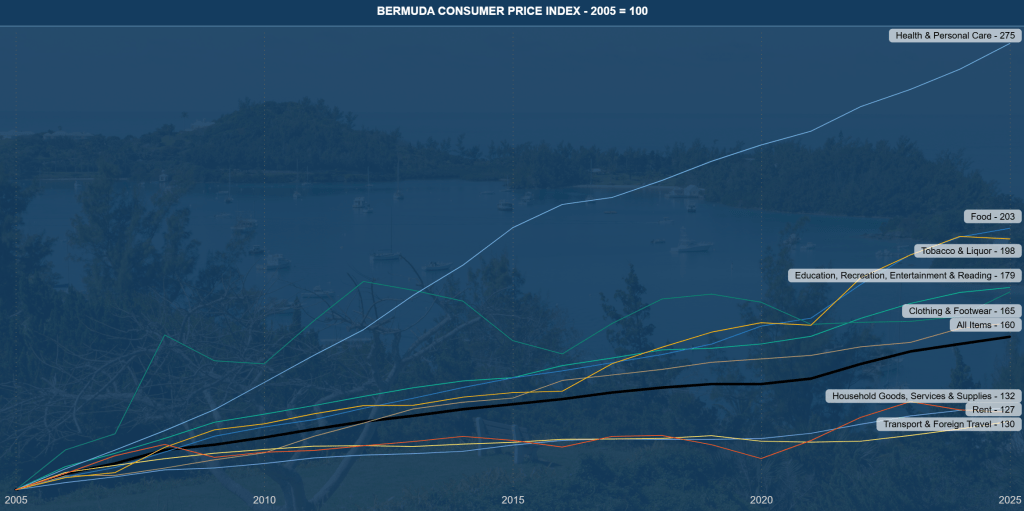
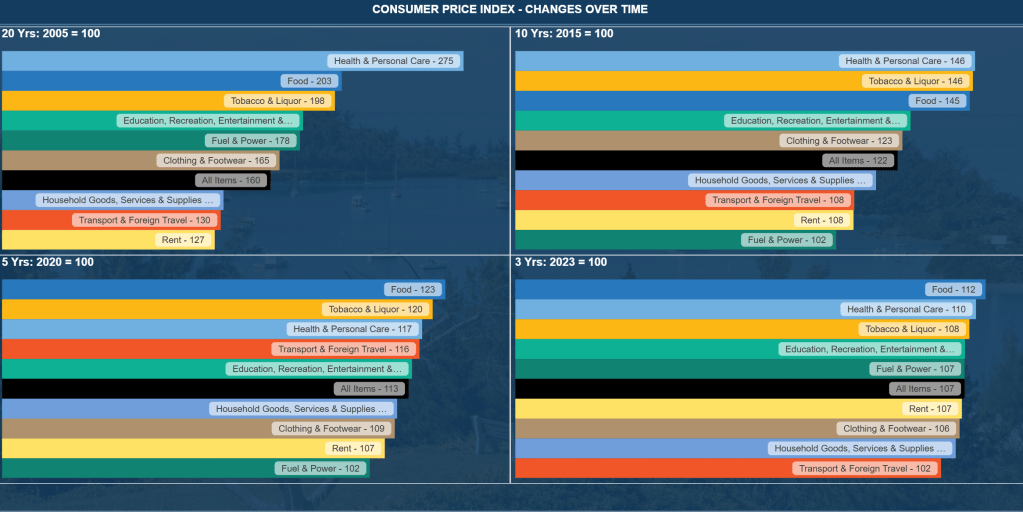
    • Overall inflation on the island is up 60% since 2005, i.e., something that was $100 in 2005 is now $160
    • There is significant variance across different types of goods and services, with healthcare being by far the largest increase, followed by food
    • Interestingly, rent is actually the lowest of all reported categories
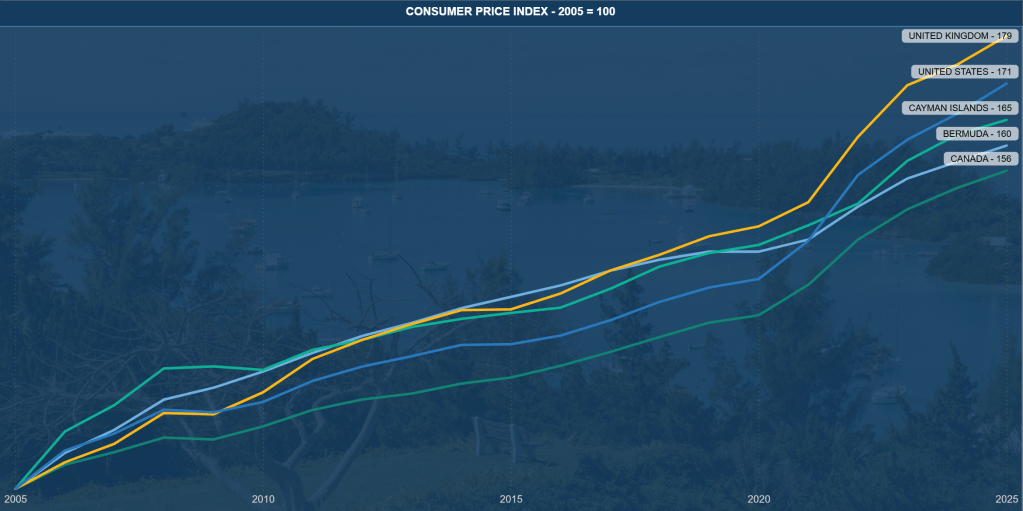
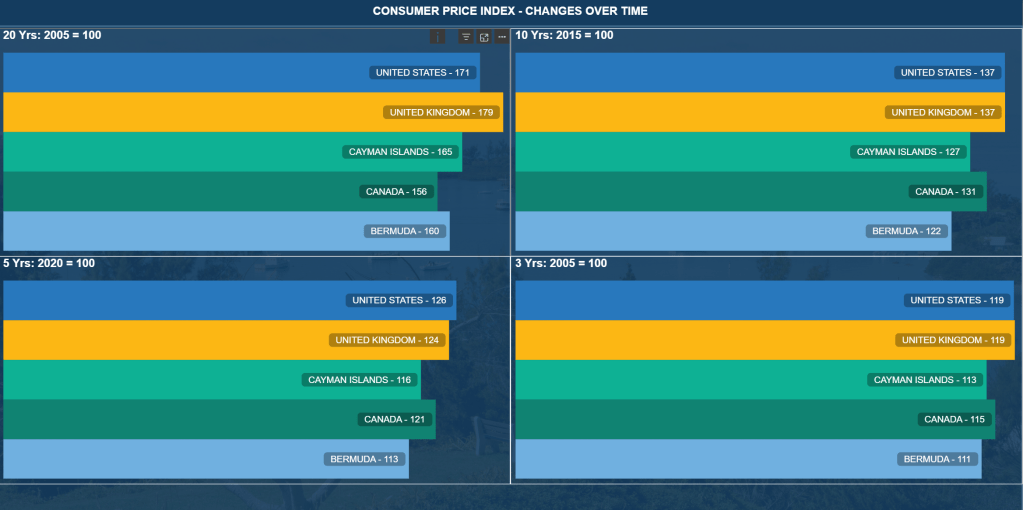
    • Compared to select other countries, Bermuda is broadly in line with Canada, but below Cayman, the US and the UK

    The dark line shows the overall Consumer Price Index (CPI) over time. This is a weighted ‘basket’ of the other categories listed out above. Most notable is the extremity of the rising costs of health and personal care, which explains why it is so high on numerous administrations’ agendas. A $100 treatment in 2005 is now $275 – an incredible rise in just 20 years. Food, tobacco and liquor have also increased significantly, roughly double what they were in 2005.

    While it may not feel as such, the statistics say that rent and household goods and services actually haven’t increased nearly as much, both under a third more expensive than 20 years ago.


    General worldwide price increases had followed each other up until 2020 or so, when the UK and the US both saw significantly higher rises than ourselves, Cayman and Canada, resulting in those 2 pulling away in terms of cost increases.

    Despite sourcing most goods and services from the included economies, Bermuda has demonstrated lower CPI, particularly over the past 5 years. in a future analysis we will look at productivity over that time, and how the price rises correlate with output.


    Certainly the feeling that groceries are significantly more expensive recently is born out in the data, with food showing the highest increase over the last 5 years. A shopping cart that cost $100 in 2020 is now over $20 more expensive just 5 years later.


  • Labour Market Deep Dive 2: Status and Occupation

    The breakdown of employees by status, occupation and gender over time yields several interesting trends and changes:

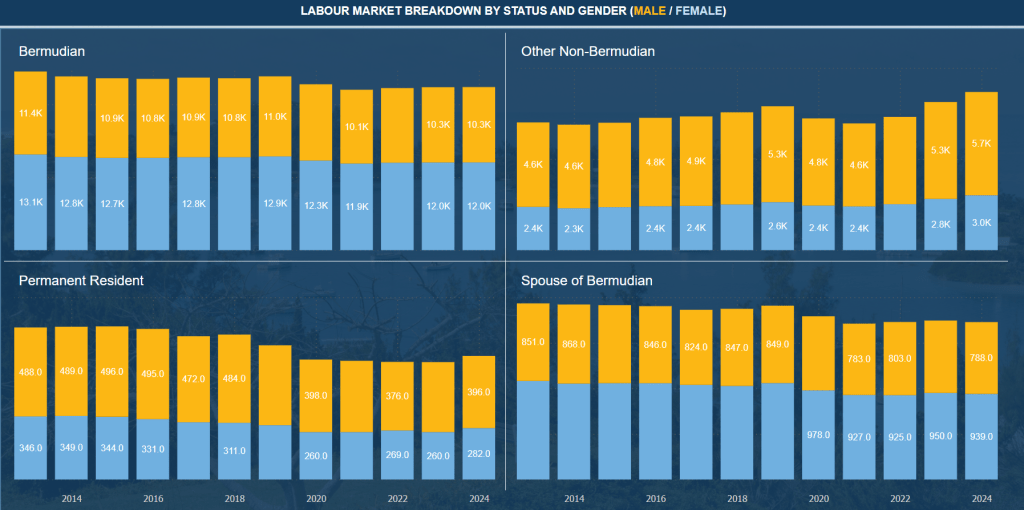
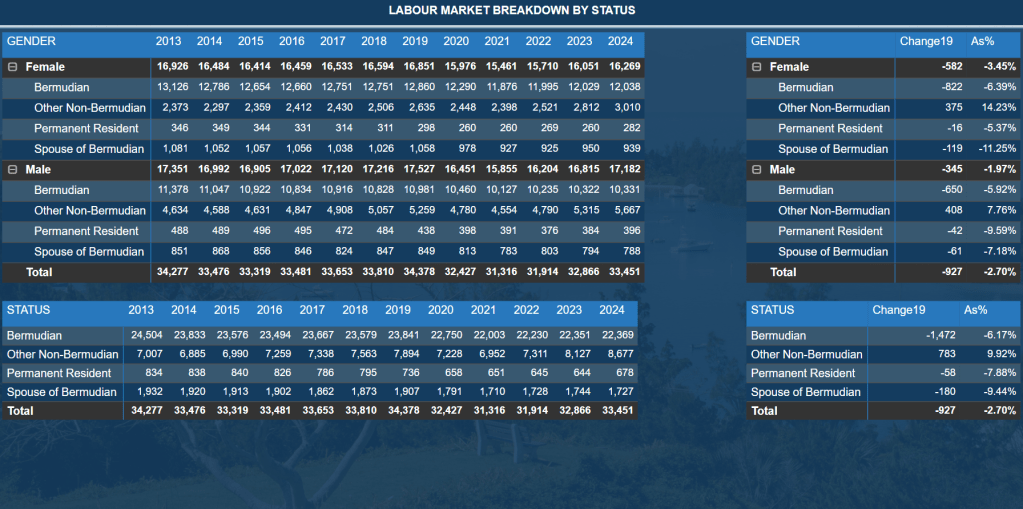
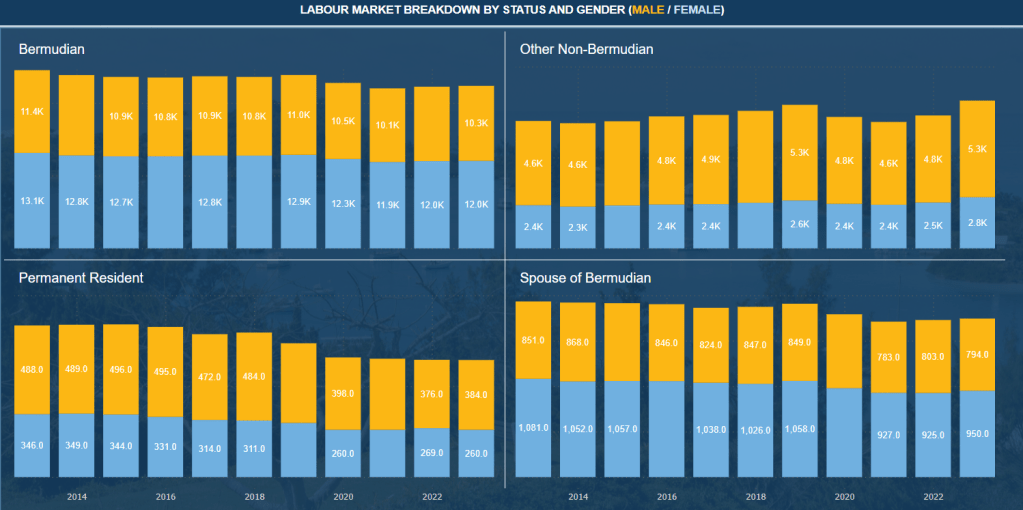
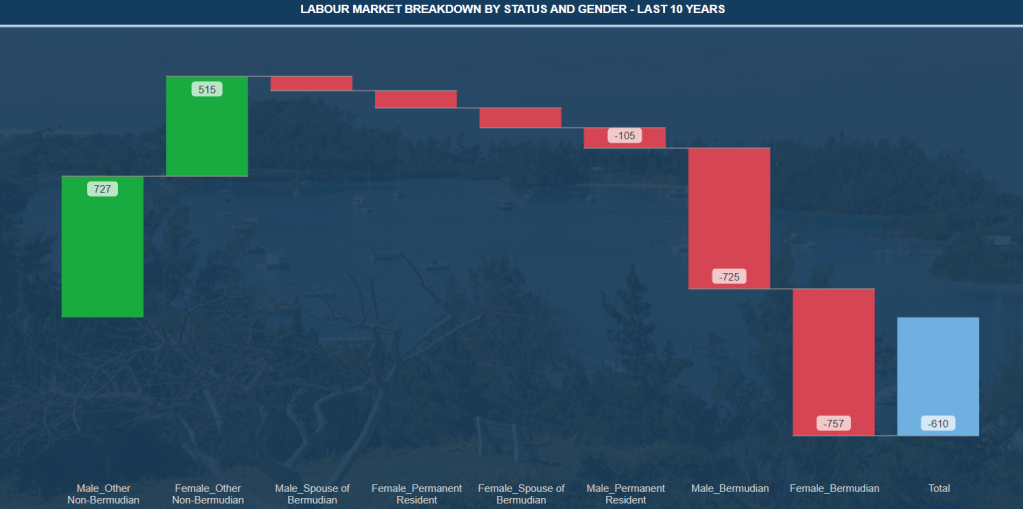
    • Over the last 10 years, almost 1,500 Bermudian jobs have been lost, reasonably equally split between male and female
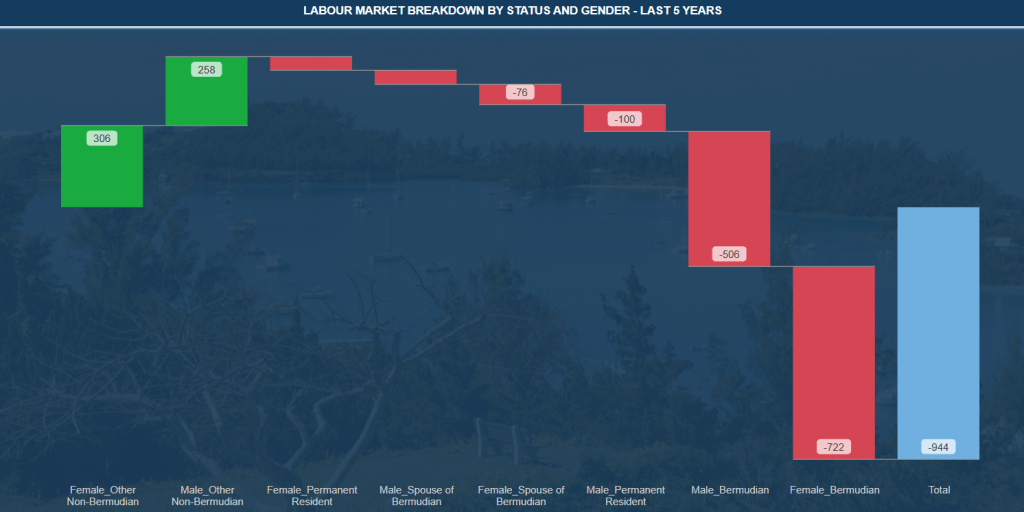
    • The majority of these falls have been in the last 5 years, with both genders dropping by more than 6%
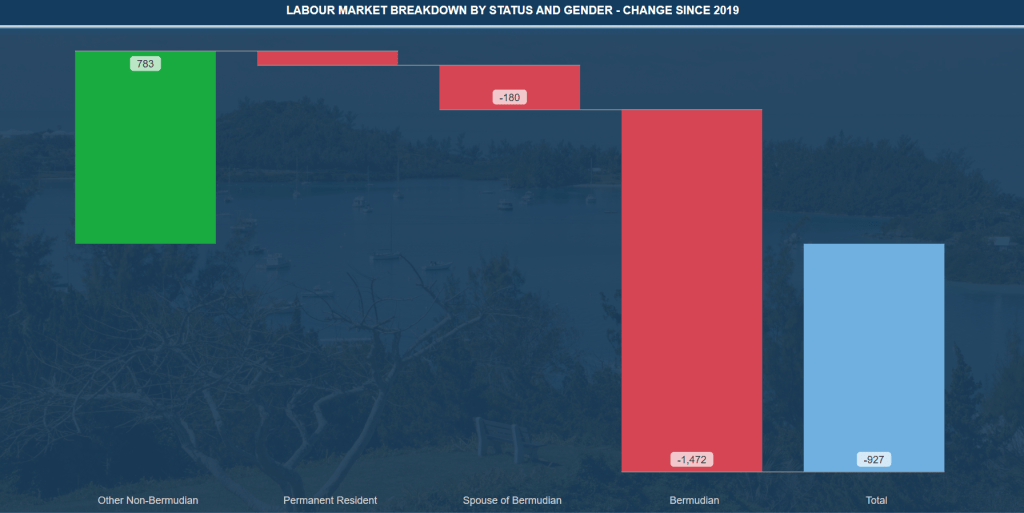
    • Other Non-Bermudian is the only status to see growth, with the majority coming from females
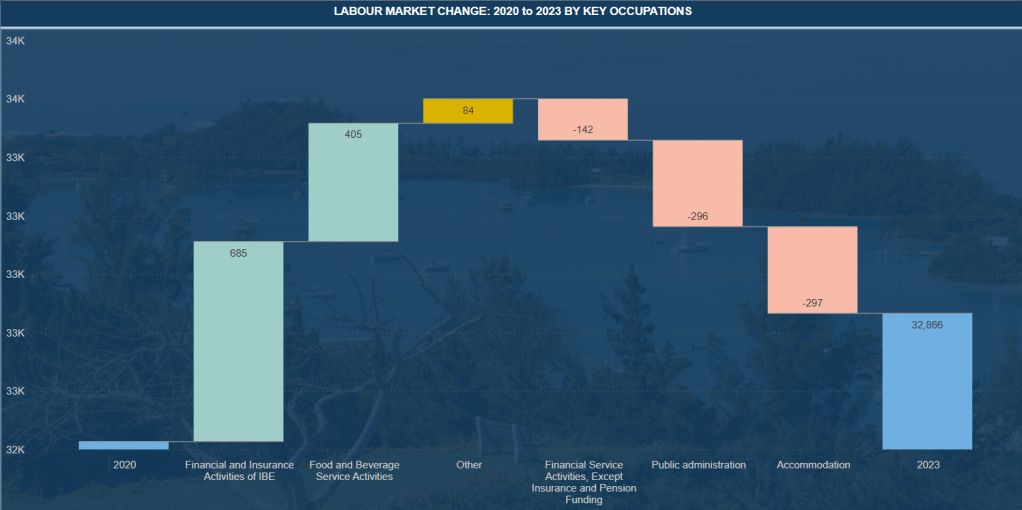
    • Since 2020, there has been a notable fall in Public administration and accommodation, while the highest growing occupation is Financial and Insurance activities of IBE

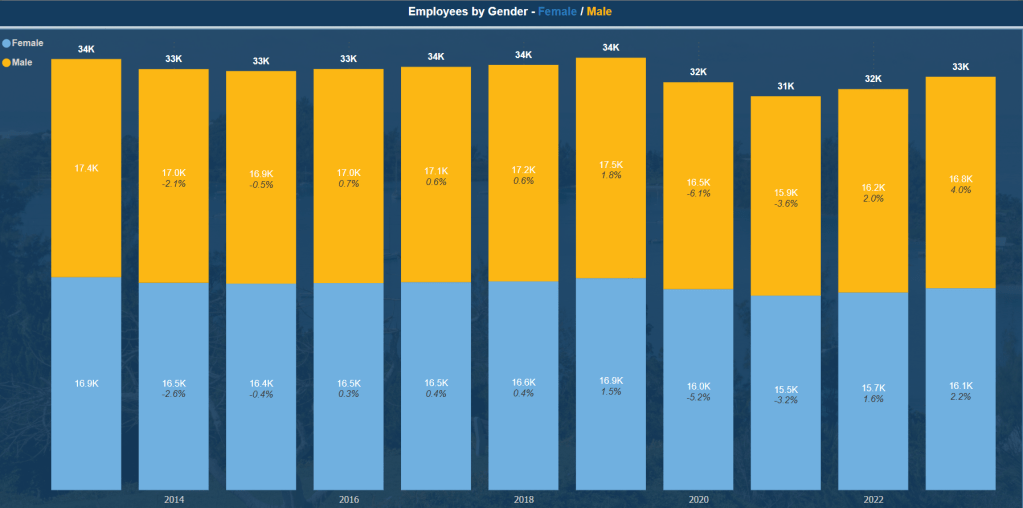
    As per the analysis on the Workforce Over Time, the overall workforce has been recovering since a substantial drop in 2020. The status breakdown helps to see the overall trends, with only ‘Other non-Bermudian’ seeing strong growth.

    The Bermudian and Spouse of Bermudian categories have not seen a full recovery, and remain lower than 2019, and indeed 2014.


    Over the last 10 years (2014-2023), there has been a clear trade-off between Bermudians and Other Non-Bermudian – for both genders. Both female and male Bermudians have seen falls of over 700 positions each.

    Most of this shift has happened in the past 5 years, with more than 1,200 Bermudians leaving the workforce.


    Unfortunately the cateogrisation of occupation saw significant changes in 2020, which makes comparisons before that difficult. However, from 2020 to 2023 can provide insight, with the vast majority of the fall in employment coming from Public administration and Accommodation – which would align with the drop in Bermudians.

    Since 2020 there has been strong growth in only two areas – and the Food and Beverage Service can largely be dismissed as a recovery from the lows of Covid-19 in 2020. The largest growth has come from Financial and Insurance activities of IBE.


  • Workforce over time

    Through presenting the total view of employment over time, it is easier to spot trends and insights into what is happening in Bermuda and her industries.


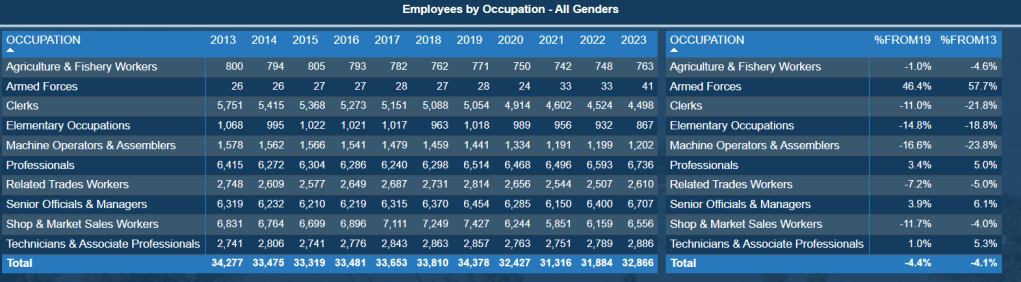
    Employment was at 34,277 in 2013, before falling through 2015. This trend was curbed and employees rose through 2019, before a significant drop of 5.7%. Since then the recovery has been gradual, and remains 4.4% below 2019 as of 2023.


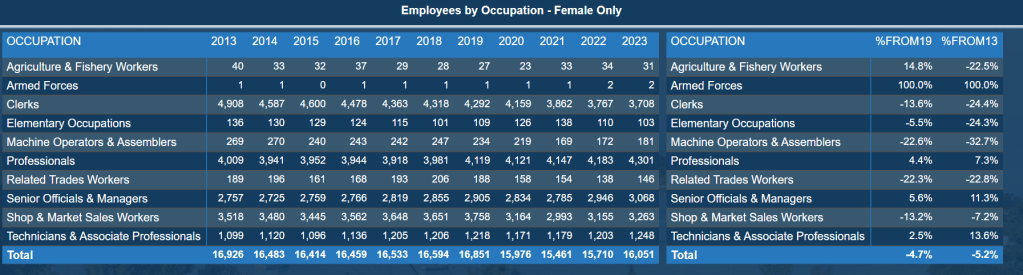
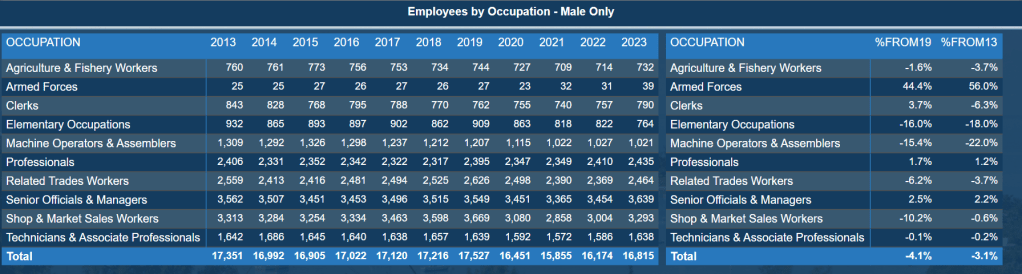
    Since 2013, female employees have fallen some 5.2%, while males just 3.1%. The fall since 2019 is more balanced, with both falling between 4% and 5%.


    There has been an overall fall in employment since 2013 of 4.1%, with the main growth coming through ‘white-collar’ occupations such as Professionals and Senior Managers, and falls across the ‘blue-collar’ occupations. Notably, Clerks are down 22%, Elementary Occupations are down 19% and Machine Operators & Assemblers are down 24%. This dynamic has continued throughout the time period.


    For females, the largest growth since 2013 has been in Technicians & Associate Professionals, growing 13.6% to 1,248 positions, and in Senior Officials & Managers, up some 11.3% to just over 3,000 positions. The largest fall has been in Clerks, down 1,200 jobs to 3,708. The highest occupation for females is Professionals, which has grown 7.3% since 2013.


    For males, positions have generally been more stable, with the highest growth in absolute terms being in Professionals and Senior Officials & Managers – combined adding some 120 positions. The largest decreases have been across Machine Operators & Assemblers, Elementary Occupations and Related Trade Workers. This shift speaks to the overall trends in the economy – with ‘blue collar’ jobs decreasing and ‘white collar’ jobs growing.

    Source: Bermuda Labour Market Statistics. Click for more details on data source